Showing posts with label tuscan. Show all posts

Saturday, February 04, 2017

Latest china acquisition: Noritake

On Fridays after a long week I like to do one of two things to relax and put a buffer between work and home. I either go driving around the pretty areas and take photos. It relaxes me to view prettiness, animals, clouds, and general green beauty.

I also love to 'play' with the photos when I get home. This means processing, cropping, adding filters, adding quotes or verses, etc.

In the second case, I like to stop in to either the second hand shop, or the vintage shop in town and see what they have for collectibles. The ladies at the 2nd hand store buy from auctions, and the ladies from the vintage shop buy from estate sales. The inventory at both shops rotates frequently and there are always some great finds or good bargains to be had.

I am currently collecting teacups and teapots. Given that I have a microscopic kitchen, this fever to collect tea paraphernalia cannot go too far! But I love to drink tea and I love beautiful things. The magazine Tea Time inspires me to try fancy recipes, and their table settings are always gorgeous. My mother had a wonderful eye for pretty things and she taught me well. Her table was always creative and beautiful.

I mean, come on, who wouldn't love this?

Tea Time Magazine

Yesterday even though it was gorgeous outside again, I decided not to go for a drive but instead go to the vintage shop. It had been many months since I was there. I had seen on their Facebook page that they had gotten a new Tea Service in, and I wanted to take a closer look. When I got there of course there were many beautiful things to look at, including some new art and a sea foam green couch that was in perfect condition for its age.

I looked at the tea set but it was Lefton, which I was not interested in. I did see some Royal Doulton espresso cups, which took me back. Not the espresso, but the pattern was my mother's china, and boy oh boy, did she have good taste. She got married in the 1950s and presumably that was when she got her Royal Doulton china. The pattern definitely stands up to age. It is still classic and beautiful.

I looked carefully around and spotted three other things which I did buy.

Noritake Glenrose pattern china cup and dish (not saucer).


Noritake Glenrose was produced between 1951-1957, which makes it mid-century and vintage. Noritake was a china company founded in 1905 in the Japanese village of Noritake. The company began exporting to the West in 1914. Noritake is good china and much of it is pretty, but if you're collecting the most prestigious, it would be better to look for Royal Doulton, Meissen, Wedgewood, or Portmerion.

Glenrose is a pretty pattern, though not especially collectible since it was very common. I am not interested in re-selling but only collecting if it appeals to my aesthetic taste. Glenrose definitely does, and it was priced well, so I bought it.


Another interesting find I discovered Friday was the cup to match a Kutani teapot I'd bought months ago at the same store.


This Japanese Kutani crackle porcelain teapot has all-over crazing under the clear glaze for a crackle design. The transfer design is an iris and bird motif with gold leaf on both sides and on the lid, with a bamboo or rattan handle. The color is an ivory or cream color. Kutani porcelains are characterized by their elaborate picture decorations in thick gold, red, blue and some other colors. In latter years I understand that these decorations were no longer hand painted but usually transferred by decal.

This teapot and now my new-to-me cup are not vintage but are extremely functional. The pot is the perfect size for three or four cups, it keeps the tea hot, and the design is growing on me more and more.

As for Kutani ware in general, according to Wikipedia,
Kutani ware (九谷焼 Kutani-yaki) is a style of Japanese porcelain traditionally supposed to be from Kutani, now a part of Kaga, Ishikawa, in the former Kaga Province. It is divided into two phases: Ko-Kutani (old Kutani), from the 17th and early 18th centuries, and Saikō-Kutani from the revived production in the 19th century. 
Obviously, the teapot and cup are not the old Kutani but the newer. Google Arts and Culture describes the history of Kutani-ware
The term Kutani ware derives from the name of the village of Kutani in the Daishōji domain. Today, Kutani is a famous hot springs destination, about 13 km from the town of Yamanaka Onsen in the city of Kaga. In the first half of the 17th century, the discovery of China stone (in Japanese, tōseki), the raw material for porcelain, ushered in the establishment of kilns in the Daishōji domain. 
The mark here is a Kutani kaku (inside a square) in a two character mark. I am unsure of the date of the piece but it's likely late 1970s, early 1980s.


I have always loved mid-century patterns of the atomic-Sputnik variety. Yesterday I found some Iroquois-ware designed by the fabulously talented Ben Seibel. Or as this etsy writer says, "pre-eminent mid century ceramic (and dinnerware, home decor) designer." I looked at many of Seibel's designs for many of his ceramic companies he'd worked for, and yes, he was a fabulously creative designer.


Iroquois Informal pattern, Harvest Time, by Ben Seibel. Mid Century mod!

You can read more about Ben Seibel and his work for Iroquois here at Mid2Mod.

The pattern is Informal, the motif is Harvest Time. The leaves were done in vibrant fall colors and deliberately given a stretched look.

Here is the pottery mark:


More about the Iroquois Pottery Company here. Harvest Time was manufactured between 1958 and 1973. I like to think my bowl is from the 1950's. If I decide so, it's true, isn't it? lol.

I am using the vegetable dish for a fruit bowl on my counter. :)

Here is the evolution of my 'Tea Bar'. In this first photo I had a few teas and one pot-


Below, I had acquired a tetsubin (Japanese cast iron teapot) and a Kutani. I also acquired my first bone china, Tuscan in Duchess pattern. Also teacups, saucers, dessert plates, and a sugar bowl in the Duchess pattern. I'd cleaned out one of my two dish cabinets up above, lol, to put my expanding library of teas in. Who needs plates and glasses and dishes, when you have tea to store?
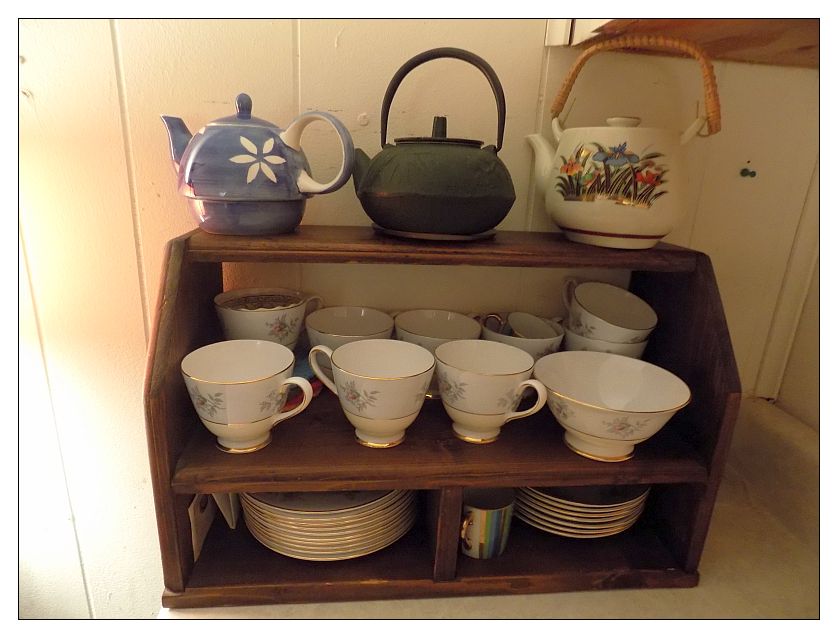


Below is the current status. Top shelf: Tetsubin, Kutani with cup, (English) Whittard teapot in Clipper pattern.

Second shelf, Duchess teacup trio, and Glenrose cup and dish. On the right is Spode butterpat. I use it to place expired teabags in or to rest my teaspoon.

Bottom shelf, the Duchess sugar bowl, and Lefton espresso creamer and cups N saucers. I have had the Lefton demitasse cups since childhood. They are hand painted 1960s classy stripes of green and gold, pottery mark pattern 251 on the bottom. I have three cups. Unfortunately one broke in all my moves from place to place over 40 years.


None of it is especially rare or expensive. But they are pretty, functional, and pleasing. And that's what matters. Thanks vintage ladies for keeping up such a good quality shop. Thanks weekends, for being there for me when I need you. Now I'm going to brew a cup of tea in my pretty kitchen. Shhh, don't wake up the cat.


Saturday, July 02, 2016

My first bone china cup: Tuscan "Duchess"

I'd like to announce a new addition to the luxury items I've carefully been collecting over the many years. From the small marble slab I use as a end table top, the Raku vase, vintage Kodak Camera, this or that piece of art ... announcing...

Bone China.

I love hot tea and write about it a lot. I subscribe to TeaTime Magazine and enjoy reading about the history of tea, types of tea, and accessories to brewing it. It is the last part I've been resisting the pull toward. One can begin collecting and never stop. That is OK for some folks, but I live in a 350sf apartment with one closet. I have no room for collections! I have enough books as it is. But tea...

Tea is small. Tea is consumable. But with tea comes ... a teapot. Another teapot. A cozy. A strainer. Perhaps an electric kettle. And teacups.

If a teacup, do I use a glass tumbler with a strainer at the top? A mug? A cup? A porcelain cup? A bone china cup?

In reading edition after edition of TeaTime I became enchanted with all the ritual and history of tea. I admired the lovely table settings charmingly displayed and expertly photographed. I got interested in the discussion of how porcelain, especially bone china, affects the taste of the tea.

Who wouldn't love to sit and sip tea at a charming little teahouse, with the beautiful mismatched china sets lain carefully at table?

current issue of TeaTime photo
I learned that bone china specifically, not porcelain and not ceramic, does enhance the taste of the tea. The UK newspaper Daily Mail had an article in 2013:
They've got it down to a tea! Scientists work out how to make the perfect cuppa... and it needs a china cup 
--Britain drinks 165 million cups of the beverage a year, but there is little agreement on exactly how a proper cuppa should be made
--Scientists say that the cup, freshness and temperature of the water as well as the precise moment the milk is added are all crucial to tea's chemistry
It seems that the bone ash added to the clay mixture plus the thinness of the cup somehow make the tea taste better. They don't really know, but that is the theory.

A friend had given me a Whittard teapot with cup, the Clipper pattern. I wrote about that here.


Whittard of Chelsea has been around since 1886. And I was off and running in loving the charm of a perfectly shaped teapot and cup. Here's Whittard with a lesson on how to brew the perfect cuppa--

Perfect Cuppa Guide

I went a direction of Japanese for a while, acquiring a tetsubin (cast iron pot) and several small Japanese cups. I like it because I like small. The tetsubin is a calming color of deep green. However I am still entranced by the china.

I have a Tea Bar, with selected herb teas, which I love. I come home from school and view the selections and choose a tea to match my mood. I've got Rooibos, a South African red bush tea that is more mellow than Red Zinger, Honey Lavender, Green tea, Chamomile, Hibiscus, Rose Hip, English Breakfast, Paris Breakfast, and Pomegranate. I'm not a huge fan of white tea, nor of fruit teas (except the pomegranate), and I like only a few Black teas. I prefer flowery herb.

I decided to buy a bone china cup and saucer. Not one to just go out and buy something, that would be silly, lol. I researched it thoroughly first. Which manufacturers are sought after, what to look for in bone china. For example, much of bone china has a gold or platinum gilding on the rim. Look for wear - is it dim, or rubbed off in spots? Hold the item to the light and if it is actual bone china it will be slightly translucent. Run your finger along the rim to check for small cracks your eye might not pick up. Learn the marks, the identifiable manufacturer mark on the bottom. Is it embedded (pre-1900, or inked, post 1900). I looked at shapes and kinds and the history of bone china. I looked at tons of pics eBay and Ruby Lane and Replacements.com and CakeStandHeaven.com sites. I made notes, printed out manufacturer marks (so as to ensure I was buying actual china), and THEN sallied forth.

There is one place in town that has vintage and antique items. I also learned the difference between vintage and antique. It cannot be called an antique if it is less than 100 years old. It's a very small town and the block on which the Shabby Chic Cottage is located has a few other stores on it, such as a ceramics gallery, an Asian grocery, and a photography studio. I poked around in the Cottage looking at their many selections of china. The lady proprietors were in absentia, either painting in their warehouse next door or speaking with one of the other store ladies along the block. That's OK, preferable actually. I saw one set I liked very much, and I took note of its properties.

Antique retailers usually sell bone china in something called a trio. It is the cup, the saucer, and a slightly larger dish on which to place your crumpet or petit four you're eating along with sipping the tea. The ladies had a good amount of trios to choose from, but since they have rolling inventory at this moment they had only a few of bone china. I went home to look up the kind I had seen and was interested in purchasing.

It contained the necessary stamp "Made in England", and also the note Bone China, from Tuscan. According to The Potteries, Tuscan was a company located at Stoke-On-Trent, founded in 1898 and sold to Wedgwood in 1966. After that its marks contained the "Royal Tuscan" designation. The entire operation ceased in 2006.
The business was a partnership between Richard Hammersley Plant and his brother Simon Lucas Plant.  They operated from the Tuscan Works in Forrister Street, Longton - which they purchased outright in 1914. The brothers became a Limited Company (R H & S L Plant Ltd.) in 1915.
Harold John Plant (Richard's son) and Frederick Sutton Plant (Simon's son) succeeded their fathers in the management of the business. Frederick died in an accident in 1939 leaving the business in the hands of Harold who continued as manging director and then as chairman until his death in 1960.
Harold's son, Richard Plant, continued the family management of the business until 1966. In 1966 RH & SL Plant were taken over by Wedgwood and the renamed "Royal Tuscan" - the works continued as a manufacturing unit of the  Wedgwood Group - producing mostly hotel ware. The works closed in 2006.

Here is the gorgeous trio I have acquired:


Right now it is 98 degrees and next week it is predicted to go above 100 real temp, so I will not be making hot tea anytime soon! But I am thrilled with the delicate colors, the ladylike pattern of the rose bud with silver leaves, and the two tone baby blue and ivory. I love it and I can't wait to add it to my Whittard and Tetsubin tea accouterments at my tea bar to be loved and admired by me.